
ResearchHome>>Research
Research
2025-11-13
On May 26, 2026, Nanchang University’s School of Architecture and Design hosted Assistant Professor Mohamed Elsadek from the Department of Landscape Architecture, College of Architecture and Urban Planning, Tongji University, for a lecture titled “Green Spaces and Well-being: Health Benefits of Nature and Design Implications.” Held in Room 414 of the Engineering Building on Qianhu Campus, the event was part of the university’s high-level thematic lecture series for its 105th Anniversary Academic Activity Month. Mohamed Elsadek’s research focuses on landscape perception, environmental health, restorative environments, and biophilic urban design. With academic experience in Egypt, Japan, and China, he received his Ph.D. from Chiba University, Japan, where he also served as a visiting researcher, and later completed his postdoctoral research at Tongji University. He is currently an Assistant Professor at Tongji University and has also held a professorship at Suez Canal University, Egypt, since 2025. His work connects landscape architecture, environmental behavior, and health-oriented design. He has led and participated in a number of research projects, published more than 30 SCI/SSCI-indexed papers, and his work has appeared in journals including Building and Environment, Urban Forestry & Urban Greening, and Environment and Behavior. He has also been listed among the World’s Top 2% Scientists. Figure 1 Mohamed Elsadek delivering the lecture In his lecture, Mohamed Elsadek discussed how natural environments contribute to human physiological and psychological well-being, drawing on international research, experimental evidence, and practical case studies. He also shared insights into the role of green spaces, plant landscapes, and multisensory environmental experiences in health-oriented design. Faculty and students from the Departments of Urban-Rural Planning and Architecture attended the lecture. During the discussion session, participants exchanged ideas with Mohamed Elsadek on urban green infrastructure, empirical methods for restorative landscape research, and the cultural adaptability of biophilic design. Figure 2 Mohamed Elsadek interacting with faculty and students The lecture broadened participants’ understanding of the health benefits of green spaces and evidence-based design approaches. It also offered valuable perspectives for teaching, research, and student training in areas related to health-oriented design, environmental behavior, and landscape practice. Written by: Junfang Xie, Shanshan ZhongAssistant Professor Mohamed Elsadek Delivers Lecture at the School
of Architecture and Design
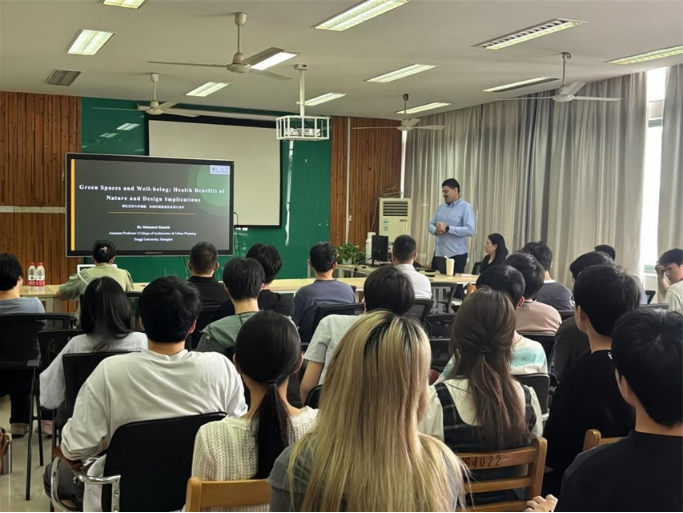
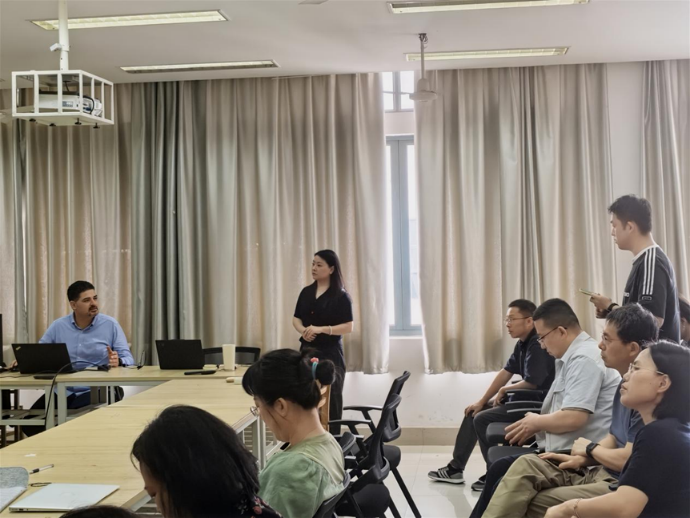
Photo by: Shanshan Zhong
Reviewed by: Jinsheng Peng, Zeng Wang, Wenhui Zheng